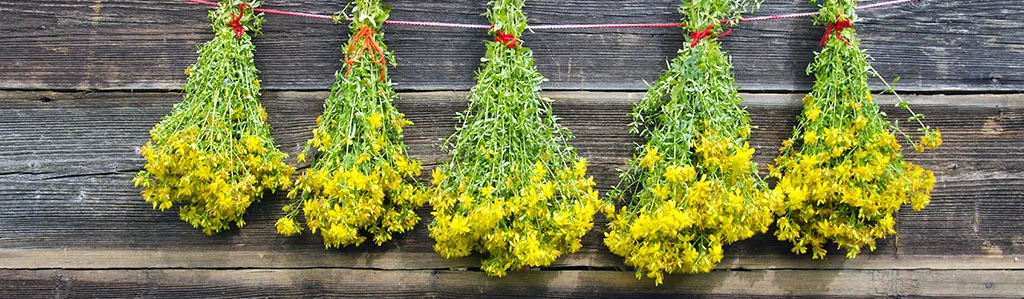
Light Bringer: St. John’s Wort
The name St. John’s Wort is linked to John the Baptist as the plant blooms from around June 24th (St. John’s Day) until August. The true medicinal St. John’s Wort thrives in dry, sunny, and barren locations, often found on roadways, embankments, or rocky slopes. It is known for its anti-inflammatory, antibacterial, and antiviral properties. The effectiveness of St. John’s Wort—whether used as tea, homeopathically, or in concentrated form—has been well recognized for a long time.
It is widely used as a mood booster and light bringer, especially for those suffering from depressive moods. Massaging St. John’s Wort oil into the body can have relaxing and pain-relieving effects, while the oil’s red hue provides gentle warmth and serves as a literal balm for the soul. However, caution should be exercised due to potential interactions with other medications. St. John’s Wort can interfere with the effectiveness of certain drugs.
Uses of St. John’s Wort:
For depressive moods
For digestive issues such as diarrhea and bloating
For cramps, particularly during menstruation
In women’s health
For developmental disorders in children and adolescents
For skin conditions and general skin care
For bladder infections
For open wounds or burns: It promotes faster healing with less scarring. Midwives historically used St. John’s Wort oil during births when perineal tears occurred. Even third-degree burns healed significantly faster than with other treatments.
For back pain, strains, and sprains: St. John’s Wort oil can be used for massages
Astringent and hemostatic properties
Harvesting Tips:
The plant’s flower tops, buds, and flowers are best harvested during its peak blooming period (between late June and August). However, they can also be dried in a suitable location. To make oil, flowers and leaves should be gathered on dry days and dried in the sun to prevent mold growth in the oil.